 +1 347 493 3907
ISO 9001
Quality management system focused on traceability, process organization and continuous improvement.


Korean translation services for USCIS immigration petitions and business. Professional certified English translation of civil, academic, and corporate records.
 ISO 9001ISO 17100
 ISO 18587
Korean translation services are often requested in the United States for immigration filings, academic records, employment procedures, family matters, legal documents and business projects. Many Korean documents include official seals, registry references, handwritten notes, date formats and names written in Hangul, so the English version needs careful handling rather than a literal word-by-word transfer.
LinguaVox prepares Korean to English translations for USCIS filings, attorneys, universities, employers, companies and private clients. The standard certified delivery is a PDF with the translated document, a certification of accuracy, signature, company stamp and professional details when appropriate. If a receiving institution expressly asks for a notarized translation, that can be reviewed as a separate service in the United States through LinguaVox’s commercial contact in Michigan.

Korean civil and administrative records usually need a complete English translation when they are submitted to a U.S. authority, university or organization. The translation should reflect all visible content, including names, dates, document numbers, issuing authorities, seals, remarks and marginal notes. When a field is blank, unclear or only partly legible, it should be handled consistently so that the translation does not add information that is not present in the source document.
Common Korean documents include basic certificates, family relation certificates, marriage certificates, divorce records, passports, police clearance certificates, academic transcripts, diplomas, corporate records, powers of attorney and court documents. Some records may include terminology from Korean civil registration systems that does not match U.S. terminology exactly. In those cases, the translation should be clear for an English-speaking reviewer without changing the legal or administrative meaning of the source.
For USCIS and similar immigration procedures, Korean-language documents are commonly translated into English with a signed certification of accuracy. LinguaVox prepares complete English translations of civil records, identity documents, academic files and supporting evidence used in family-based petitions, adjustment of status, naturalization, visa-related filings and other immigration matters.
USCIS filings normally require the translation to be complete and accompanied by certification wording from a competent translator or translation provider. USCIS does not normally require notarization as a general rule, but an attorney, court, university or other receiving institution may ask for a notarized version in a specific case. For that reason, the intended use should be explained before the quote is confirmed.

Names written in Hangul are romanized or transliterated into the Latin alphabet; they are not translated. This is important because the same Korean name can appear in different forms depending on the passport, previous immigration filings, university records or family documents. If the client already uses a specific spelling in a passport, green card, visa, diploma or prior application, that spelling should be sent with the documents.
LinguaVox reviews names, places and institutional references carefully and applies consistent spelling across the translation package when appropriate. This helps avoid unnecessary differences between the translation and the rest of the client’s supporting documents. Dates, addresses and official titles are also checked so the English version can be read clearly by the receiving institution.
Korean translation is not limited to immigration. Students, professionals and universities may need diplomas, transcripts, course descriptions, recommendation letters or academic certificates translated into English for admission, credential evaluation or employment. These files require attention to course titles, grades, institutional names and academic formats.
Companies may need Korean to English or English to Korean translation for contracts, technical manuals, product specifications, financial statements, corporate policies, websites, compliance documents and presentations. In these projects, terminology consistency is important. LinguaVox can work with glossaries, translation memories, style instructions and formatting requirements when the project needs a controlled multilingual workflow.
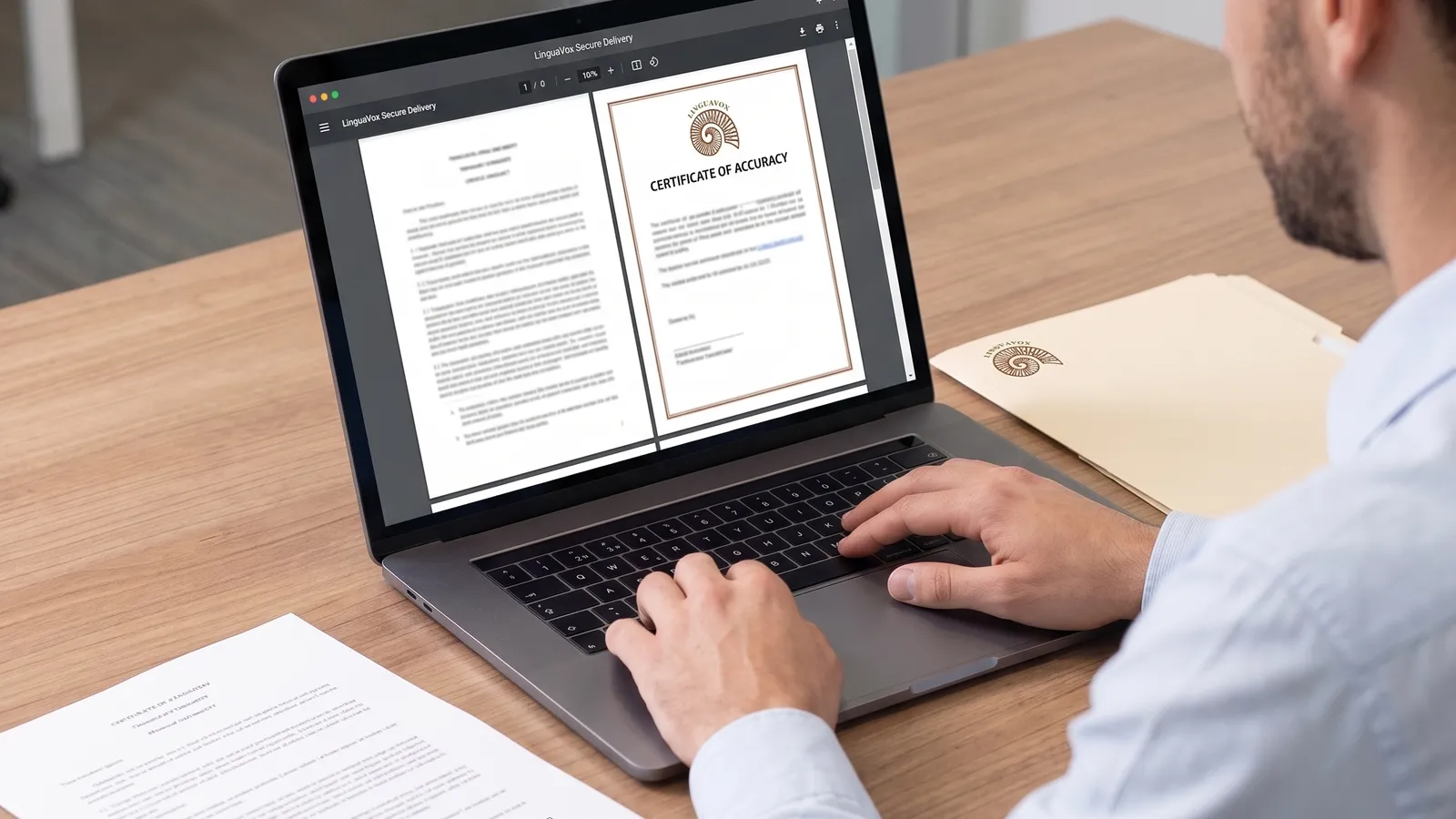
Most certified Korean translations are delivered electronically. PDF delivery is practical for online filing, attorneys, universities and many receiving institutions when electronic submission is allowed. The file includes the translation and certification page so the client can upload, print or forward it without waiting for postal delivery.
A notarized translation is different from a certified translation. If a court, attorney, university or agency asks for a certificate signed before a U.S. notary, LinguaVox can coordinate that step through its commercial contact in Michigan and arrange postal delivery of the physical package. This option has an additional cost and takes longer than the standard certified PDF delivery.
Each Korean translation project is reviewed according to the document type, language direction, intended use and delivery format. LinguaVox combines project management, translator selection, revision when required and final checking before delivery. For multilingual or recurring business projects, glossaries and translation memories can help maintain consistent wording across files, departments and language pairs.
LinguaVox’s processes are organized with reference to ISO 9001 quality management, ISO 17100 professional translation service requirements and ISO 18587 human post-editing workflows when that service is specifically requested. The quote is confirmed before work starts and states the language pair, document type, delivery format and estimated turnaround time.
Quality management system focused on traceability, process organization and continuous improvement.
Specific standard for professional translation services with independent revision.
Standard used for human post-editing of machine translation when that workflow is requested.
These pages may be useful when the same file also involves USCIS requirements, certified delivery or translation from another language.
It includes a complete English translation of the Korean document and a signed certification of accuracy. The file usually includes the translation, certification wording, signature, company stamp and professional details when appropriate. This format is commonly used for USCIS, academic and legal procedures when allowed by the receiving institution.
Korean names are romanized or transliterated into the Latin alphabet; they are not translated. If you already have a spelling in a passport, visa, green card, diploma or previous application, send that reference with the document. LinguaVox can then keep names consistent across the translation package where appropriate.
USCIS filings commonly use certified English translations with a signed certification of accuracy. Notarization is not a general USCIS requirement, but an attorney, court, university or other institution may request it for a specific procedure. If notarization is required, LinguaVox can coordinate it as an additional service.
Yes. You can send clear scans or photographs of Korean documents online from anywhere in the United States. A project manager reviews the files, confirms the language direction, document type and delivery format, and sends a quote before the translation starts.
Common documents include basic certificates, family relation certificates, marriage records, divorce documents, passports, police clearance certificates, diplomas, transcripts and court papers. Business clients may also request contracts, technical manuals, corporate records, financial statements and website content.
Yes. LinguaVox handles Korean to English and English to Korean projects for business, legal, academic and corporate use. Certified English translations are common for U.S. procedures, while English to Korean projects are usually prepared for Korean-speaking readers, companies or institutions.
Request a translation quote
Send the documents, specify the language and explain where the translation will be submitted. We will check whether you need certified PDF delivery, notarization or postal delivery.