 +1 347 493 3907
ISO 9001
Quality management system focused on traceability, process organization and continuous improvement.


Certified translation services in the United States for USCIS, universities, courts, employers, banks and official procedures. Certified PDF delivery, notarization when required.
 ISO 9001ISO 17100
 ISO 18587
Certified translation services are used when a document written in another language must be submitted with a signed statement confirming that the translation is complete and accurate. LinguaVox prepares certified translations for individuals, attorneys and companies presenting documents to immigration authorities, universities, credential evaluators, state courts, employers, banks and public agencies in the United States.
Many people first look for certified translation because of an immigration filing, but the same type of service is also used in academic, legal, employment, banking and corporate procedures. The important point is not just the language pair. The translation must reflect the whole document clearly, including names, dates, stamps, seals, handwritten notes and official references that may matter to the receiving institution.

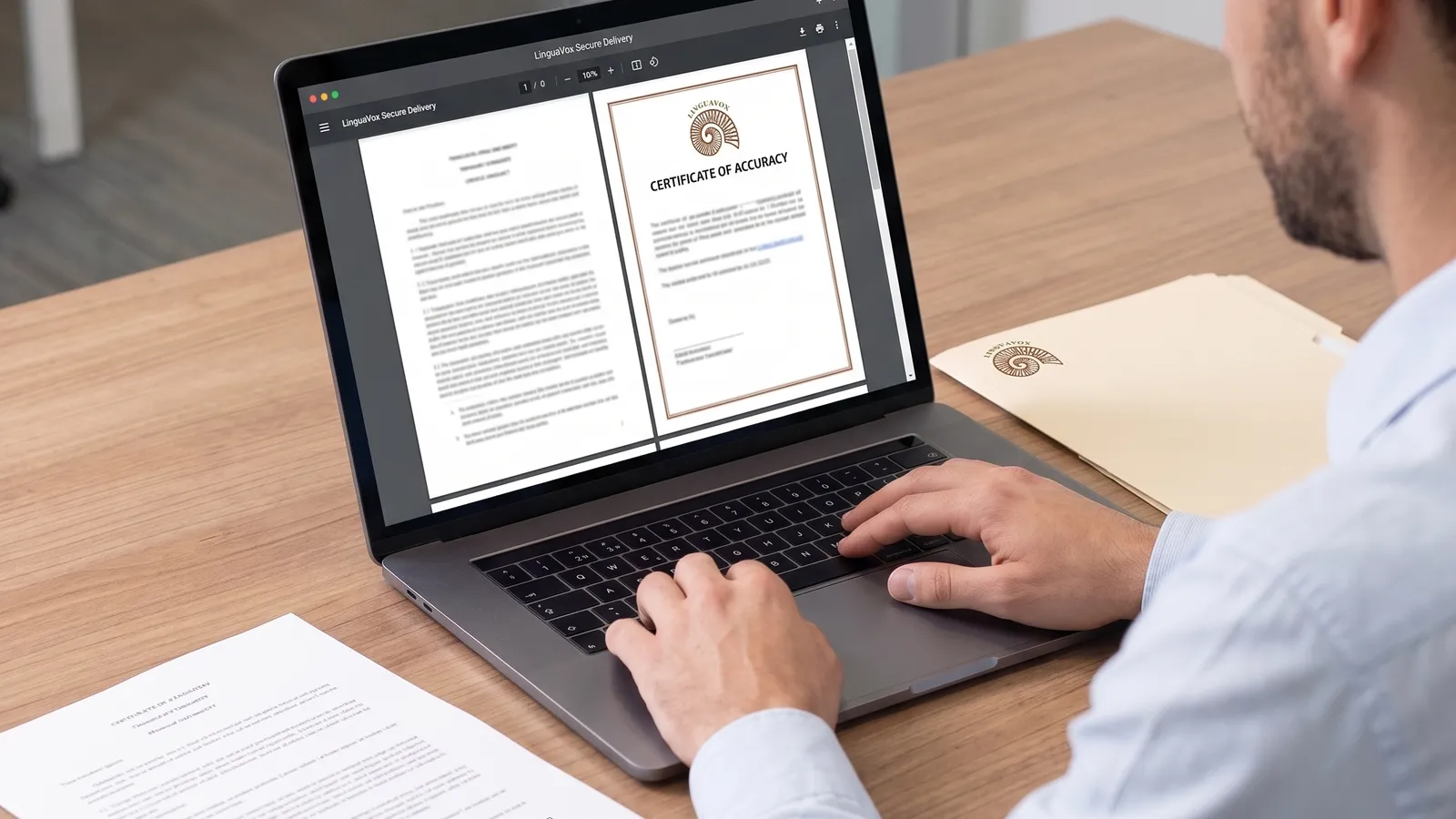
A certified translation normally includes the translated document and a certification statement. The statement confirms that the translation is complete and accurate to the best of the provider's knowledge and ability. LinguaVox includes company details, a signature and a corporate stamp on the certification so the receiving organization can identify the translation provider.
The translated file should also be easy to review. Official documents often contain details that are not part of the running text: seals, registry numbers, signatures, margins, notes, abbreviations or partially legible stamps. These elements must be represented in a practical way so the person reviewing the file can compare the translation with the source document.
For USCIS filings, documents issued in a foreign language generally need to be translated into English and accompanied by a certification of accuracy. LinguaVox prepares certified translations of birth certificates, marriage certificates, divorce decrees, police records, passports, affidavits, diplomas, academic transcripts and supporting identity documents for immigration-related use.
Certified translations are also requested outside immigration. A university may need a transcript translation before reviewing an admission file. A credential evaluator may request a certified diploma translation. An employer or HR department may ask for a marriage certificate or academic document. Courts, banks and licensing boards may also require certified translations for specific procedures.

LinguaVox provides certified translation services in more than 150 languages. Spanish to English is one of the most common combinations in the United States, especially for civil, academic and legal documents. We also handle certified translations from Chinese, Arabic, Vietnamese, Tagalog, Korean, Russian, Portuguese, Haitian Creole, Hindi, Urdu, Farsi, Ukrainian and many other languages.
Documents from different countries may use different alphabets, calendars, naming conventions and official formats. A certified translation must handle those differences carefully. For example, names from Arabic, Russian, Ukrainian, Chinese or Farsi documents may require consistent transliteration into the Latin alphabet. Dates, seals and official titles must also be treated in a way that is clear for an English-speaking reviewer.
For many certified translations in the United States, the standard delivery format is a PDF containing the translation and the signed certification. This format is practical for online uploads, email submissions and digital filing systems when the receiving institution accepts electronic documents.
Some institutions require extra steps. If a specific court, university, licensing board or agency asks for a notarized translation, LinguaVox can arrange for the certification signature to be completed before a U.S. notary public through our local contact in Michigan. The physical notarized document can then be mailed to the client. Notarization adds cost and processing time, so we handle it only when the client requests it or when the receiving institution requires it.
LinguaVox also translates English documents into other languages when the receiving authority is outside the United States. In those cases, requirements can change significantly. Spain, for example, may require a sworn translation by a translator appointed by the Spanish Ministry of Foreign Affairs for certain official uses. Other countries may require notarization, legalization, apostille or a specific local format.
When the document will be used abroad, it is important to confirm the destination country's instructions before ordering the translation. LinguaVox can review the intended use and explain which translation route is likely to fit the procedure, without presenting any external acceptance as automatic.
Certified translation projects are managed with attention to completeness, accuracy, layout, certification wording and delivery format. LinguaVox applies organized project management, translator selection, revision where required and final checks before delivery. Our work is supported by ISO 9001 for quality management and ISO 17100 for professional translation service processes when that workflow applies.
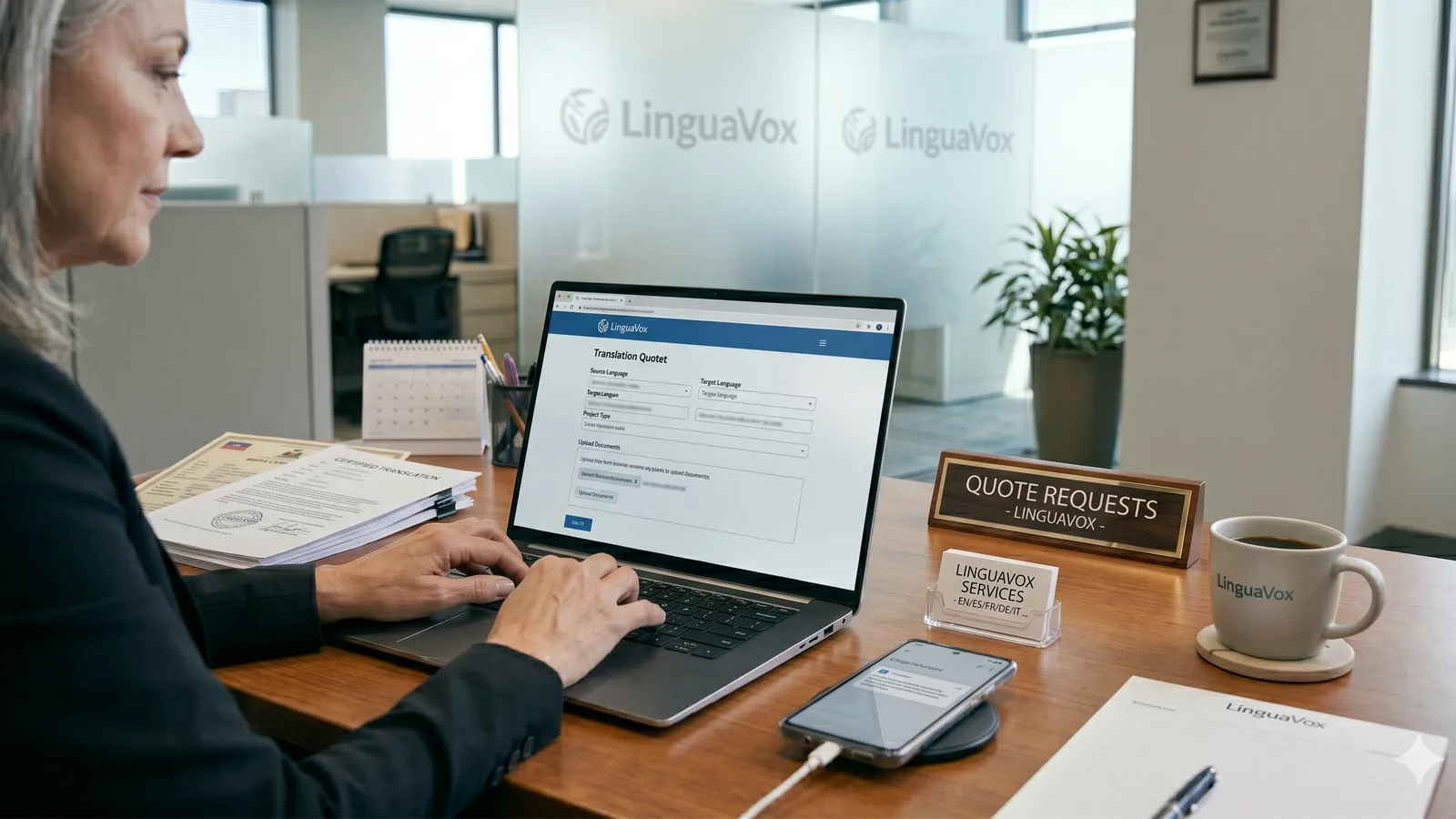
To request a quote, send scanned documents or clear photos, indicate the target language and tell us where the translation will be submitted. We will review the file, estimate the scope and confirm whether standard certified PDF delivery is enough or whether notarization and postal delivery should be included.
Quality management system focused on traceability, process organization and continuous improvement.
Specific standard for professional translation services with independent revision.
Standard used for human post-editing of machine translation when that workflow is requested.
Explore related services when your project combines certified translation, USCIS documents, business files, languages or state-specific delivery needs.
A certified translation includes the translated document and a signed statement of accuracy from the translation provider. The statement confirms that the translation is complete and accurate to the best of the provider's knowledge and ability. Many U.S. institutions request this format for foreign-language documents.
No. A certified translation and a notarized translation are not the same thing. Many procedures accept a certified PDF, while some courts, universities or licensing boards may ask for notarization. You should request notarization only when the receiving institution requires it or when your instructions say so.
The translator reviews the visible elements of the source document and reflects them in the translation in a clear way. Stamps, seals, signatures, handwritten notes and illegible sections may be indicated in brackets. This helps the reviewer compare the translation with the original file.
Yes. We regularly translate documents from languages such as Arabic, Chinese, Russian, Ukrainian, Farsi and Korean. Names and places may require transliteration into the Latin alphabet, so consistency across the whole document is important.
Standard certified translations are delivered by email as a PDF containing the translation and the certification statement. If you request notarization, the certification is signed before a U.S. notary and the physical document can be mailed to your address.
Yes. LinguaVox translates English documents into more than 150 languages. Requirements vary by country, so you should check whether the destination authority asks for a sworn translation, notarization, apostille, legalization or a specific local format.
Request a translation quote
Send the documents, specify the language and explain where the translation will be submitted. We will check whether you need certified PDF delivery, notarization or postal delivery.