 +1 347 493 3907
ISO 9001
Quality management system focused on traceability, process organization and continuous improvement.


Patent translation services for innovation teams and IP law firms. We translate patent claims, prior art, and office actions in over 150 languages.
 ISO 9001ISO 17100
 ISO 18587
Patent translation occupies a highly specialized space at the intersection of complex technical writing and strict legal formatting. The wording in intellectual property documents must be handled with particular precision across claims, descriptions, and accompanying figures. LinguaVox provides professional patent translation services for innovation teams, corporate R&D departments, and intellectual property law firms in the United States and international markets.
A small variation in terminology can affect the reading of a patent claim and, in some contexts, the protection sought for an invention. Our translation workflow is designed to manage this risk by prioritizing terminological consistency, technical review, and adherence to the specific formatting requirements of national and international patent offices.

Our patent translation services cover the full lifecycle of intellectual property documentation. For the initial filing and prosecution phases, we translate patent specifications, abstracts, detailed technical descriptions, and the claims themselves. We also carefully extract and translate the text embedded within technical drawings and diagrams, formatting the final document so it is prepared for submission.
During the examination process or in the context of patent litigation, we translate prior art documents, international search reports, office actions from foreign patent examiners, and legal correspondence. Whether you are validating a European patent, filing a PCT application, or reviewing a competitor's technology, the translation process is adapted to suit the document's specific legal or informational purpose.
In patent translation, consistency is not optional. The terms used in the patent claims must perfectly match the terms used in the detailed description and the drawings. Using synonyms for a specific mechanical part or chemical compound can introduce ambiguity into the application.
To prevent this, LinguaVox employs translation memories and specialized glossaries. If your engineering team or patent attorney has a preferred list of terms, we integrate it into our workflow. This helps keep the vocabulary stable throughout the document and across later office actions or related filings. Our project managers assign these highly technical texts to linguists who have experience with the specific subject matter, whether it involves biotechnology, mechanical engineering, software algorithms, or pharmaceuticals.

LinguaVox translates patent documents in more than 150 languages. Given the global nature of intellectual property, we frequently handle projects involving the world's most active patent jurisdictions.
We routinely prepare English translations of patents and prior art originally published in Japanese, Chinese, Korean, and German. We also translate U.S. patent applications from English into Spanish, French, Portuguese, Russian, and Arabic for national phase entries abroad. Our teams adapt the documentation to reflect the specific conventions, numbering systems, and structural requirements of the target country's patent office.
Delivery formats: Standard, Certified, and Litigation Support
The format of the final translation depends on why the document is being translated. If your R&D team is reviewing foreign prior art for information purposes, we provide a standard professional translation in a clean, editable format. This helps your engineers assess the relevance of the technology.
If the translation is being submitted to the United States Patent and Trademark Office (USPTO), a foreign patent office, or a court of law during an infringement lawsuit, a certified translation may be required. In these instances, we deliver a secure PDF that includes the translation and a formal certification of accuracy signed by our agency.
For IP litigation matters where a court or attorney requires notarized documentation, we can arrange for the certification of accuracy to be signed before a U.S. notary public. We coordinate this service via our contact in Michigan and mail the physical, notarized documents to your legal team. This step adds processing time and is managed when the client or receiving institution requests it.
Our patent translation processes follow documented quality management procedures. We adhere to ISO 9001 for project traceability, ensuring secure and organized handling of your sensitive IP data. The translation and revision workflows follow ISO 17100, including revision requirements.
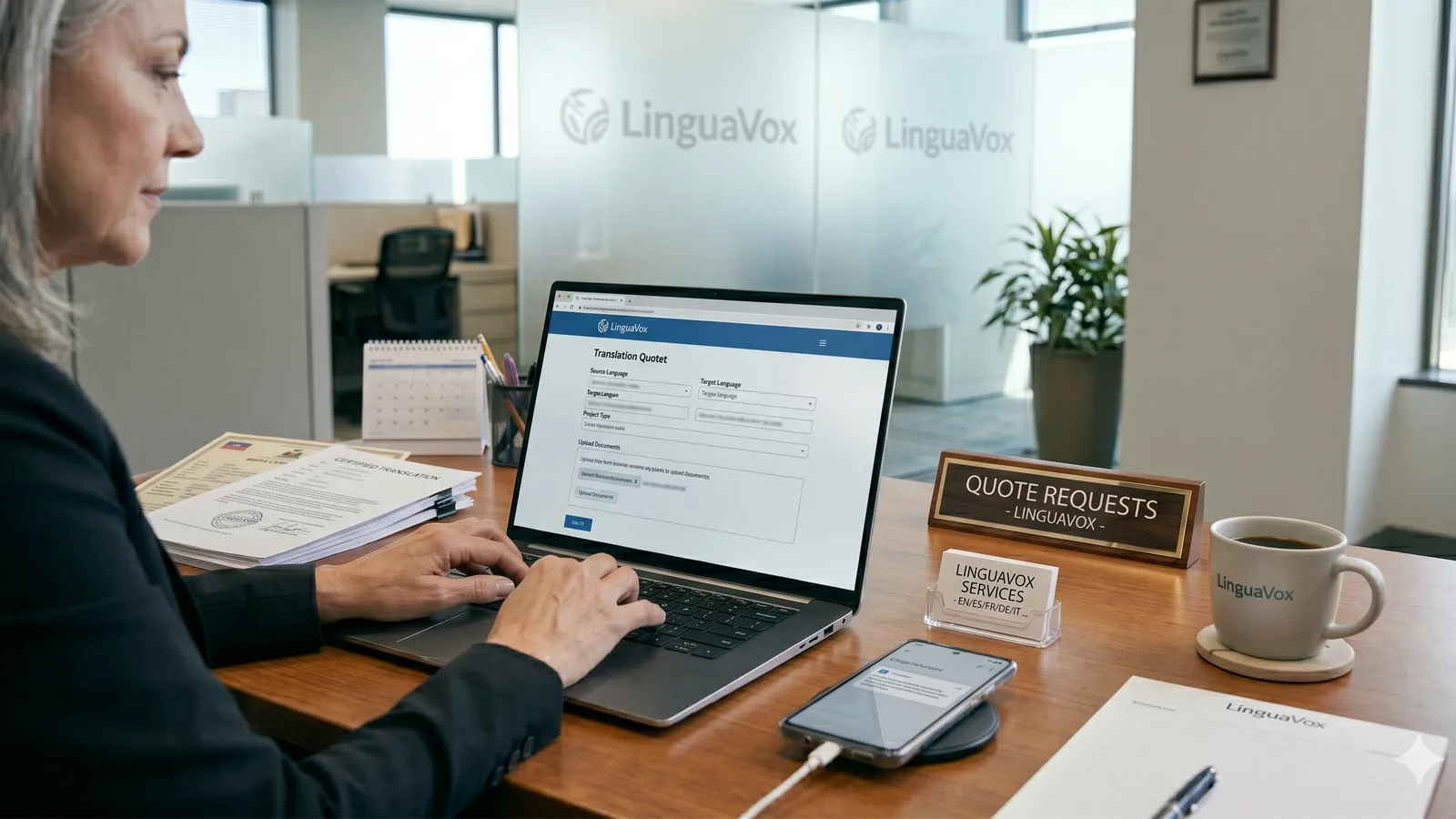
To receive a quote, securely send us your patent documents or prior art files. Please specify the target language, the field of technology, and the intended use of the translation (e.g., filing, litigation, or internal review). Our team will assess the technical complexity, word count, and formatting requirements to provide a comprehensive quote with clear delivery timelines.
Quality management system focused on traceability, process organization and continuous improvement.
Specific standard for professional translation services with independent revision.
Standard used for human post-editing of machine translation when that workflow is requested.
Explore related services when your project combines certified translation, USCIS documents, business files, languages or state-specific delivery needs.
We translate the entire patent application, including the abstract, background, detailed description, claims, and the text within technical drawings or figures. We can also translate specific sections only if you just need the claims or abstract for review.
We extract the text from the drawings, translate it, and format the final document so that the translated labels correspond clearly to the original reference numbers or figures, preparing the file for review or submission.
Yes, we frequently translate prior art documents (such as foreign patents or scientific journal articles) for R&D review, as well as office actions and search reports from international patent examiners.
Yes, if the translation is being submitted as evidence in a court case or formally submitted to a patent office, a certified translation with a certification of accuracy is usually required. Internal informational reviews generally only need a standard professional translation.
The most frequently requested languages for patent translation include Japanese, Chinese, Korean, German, and French, reflecting major jurisdictions and markets for research and intellectual property filing.
Yes. If the national patent office of the destination country or a specific court requires a notarized translation, we can manage the notarization through our Michigan contact and mail the physical documents to you.
Request a translation quote
Send the documents, specify the language and explain where the translation will be submitted. We will check whether you need certified PDF delivery, notarization or postal delivery.