 +1 347 493 3907
ISO 9001
Quality management system focused on traceability, process organization and continuous improvement.


Legal translation services for law firms, corporations, and individuals. We translate contracts, court documents and corporate records in more than 150 languages.
 ISO 9001ISO 17100
 ISO 18587
Legal documents require specialized attention because the terminology carries direct obligations, rights, and potential liabilities. A literal translation is often insufficient when bridging two different legal systems. LinguaVox provides legal translation services for law firms, corporate legal departments, and private individuals in the United States, with careful attention to legal terminology, formatting and the intended use of each document.
We process documentation for civil litigation, corporate compliance, real estate transactions, and international business agreements. The translation workflow is adapted to the nature of the file and to the institution or person that will receive it, whether that is a court, a government agency, a business partner or a private attorney.

Our legal translation services cover a wide spectrum of documents. For corporate clients and business negotiations, we translate commercial contracts, non-disclosure agreements (NDAs), articles of incorporation, terms of service, and corporate bylaws. In these projects, preserving the meaning of clauses and obligations is critical for international partnerships and compliance.
For litigation and court proceedings, we translate evidence files, court orders, divorce decrees, witness statements, and expert reports. We also support individuals and immigration attorneys by translating personal legal documents such as powers of attorney, affidavits, police records, and adoption papers. Our translators work through these documents methodically, paying attention to legal concepts, institutional names and official stamps.
Legal systems vary significantly from one country to another. A legal concept in a civil law system (such as those in Latin America or continental Europe) may not have a direct equivalent in the U.S. common law system. In these cases, the translation requires careful terminology choices that convey the legal meaning of the original without creating ambiguity for the U.S. reader.
To manage this complexity, LinguaVox works with translators who are familiar with legal documentation. For large-scale litigation cases or ongoing corporate work, we use translation memories and client-specific glossaries. This helps keep legal terms, company names and contractual clauses consistent across long files and later projects.
LinguaVox manages legal translation projects in more than 150 languages. In the United States, we process a significant volume of Spanish-to-English translations, assisting clients with legal documents issued in Mexico, Colombia, Argentina, Spain, and other Spanish-speaking jurisdictions. We also frequently translate U.S. legal documents from English into Spanish for cross-border business or international litigation.
Additionally, we handle extensive legal translation projects from Chinese, Arabic, Vietnamese, Tagalog, Korean, Russian, Portuguese, Haitian Creole, Hindi, Urdu, Farsi, and Ukrainian. Our project managers assign these files to linguists familiar with the specific legal formatting and registry conventions of the source country.
The appropriate delivery format depends on how the translation will be used. If you are negotiating a contract or reviewing evidence internally, we provide a standard professional translation in an editable format (like Microsoft Word). This allows your legal team to easily integrate, highlight, or edit the text during the review process.
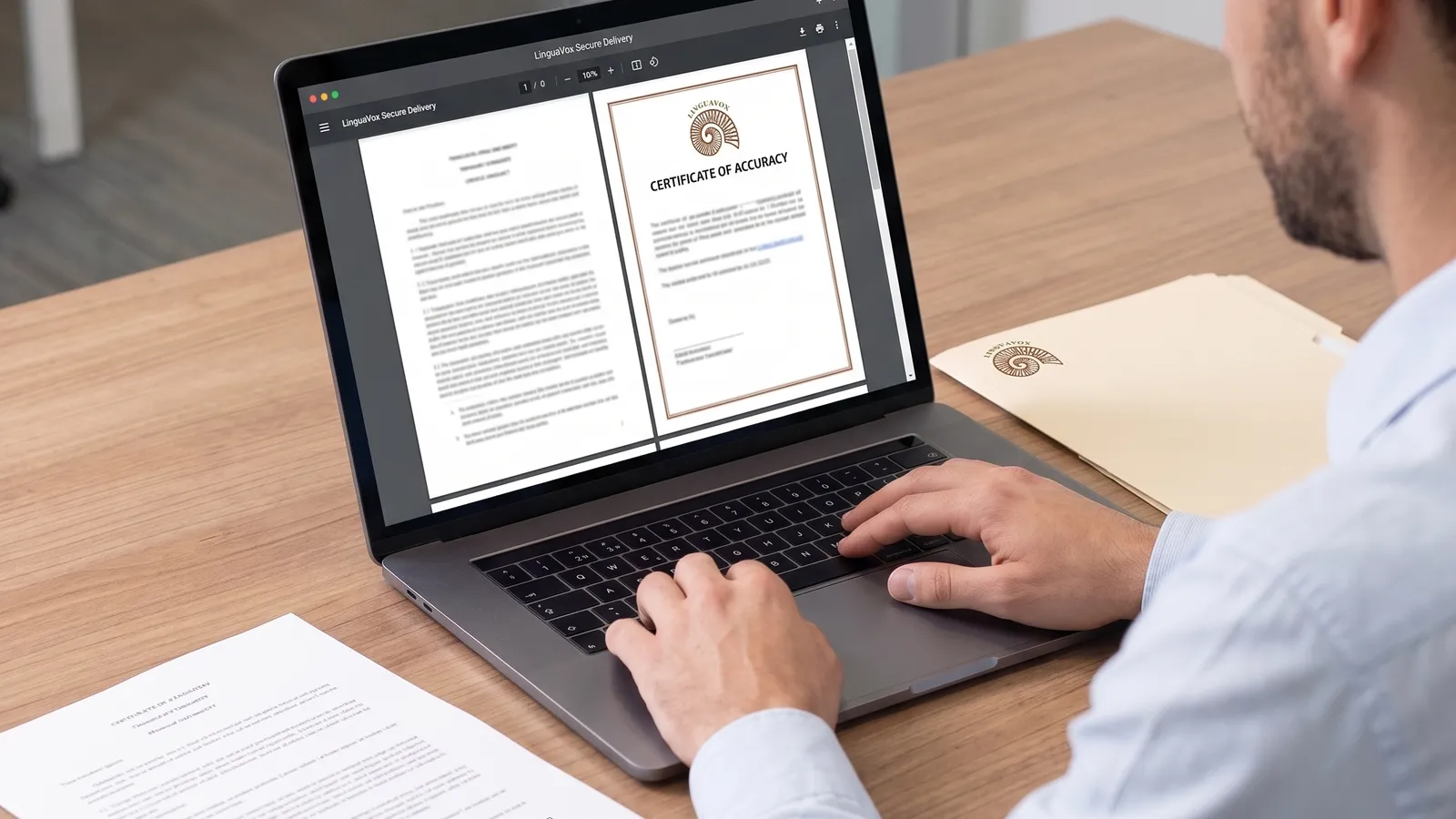
However, if the document is going to be submitted to a U.S. court, an immigration authority, a university, or a public registry, it usually requires a certified translation. In this scenario, we provide a secure PDF that includes the complete English translation alongside a formal certification of accuracy, signed and stamped by our agency. This format is commonly requested for official procedures.
If a specific judge, state agency, or foreign registry explicitly requires a notarized translation, LinguaVox can coordinate this additional step. We arrange for our certification of accuracy to be signed before a U.S. notary public through our local contact in Michigan. The notarized physical documents are then sent to your office or home by postal mail. Because notarization adds processing time and shipping costs, it is offered as an optional service when the receiving institution’s instructions require it.
Our legal translation workflows follow documented quality processes. We follow ISO 9001 for process organization and project traceability. The translation phase is governed by ISO 17100, which sets requirements for translator selection, project management and revision. When a corporate client requests post-editing of machine translation for large document sets, we apply the human post-editing criteria outlined in ISO 18587.
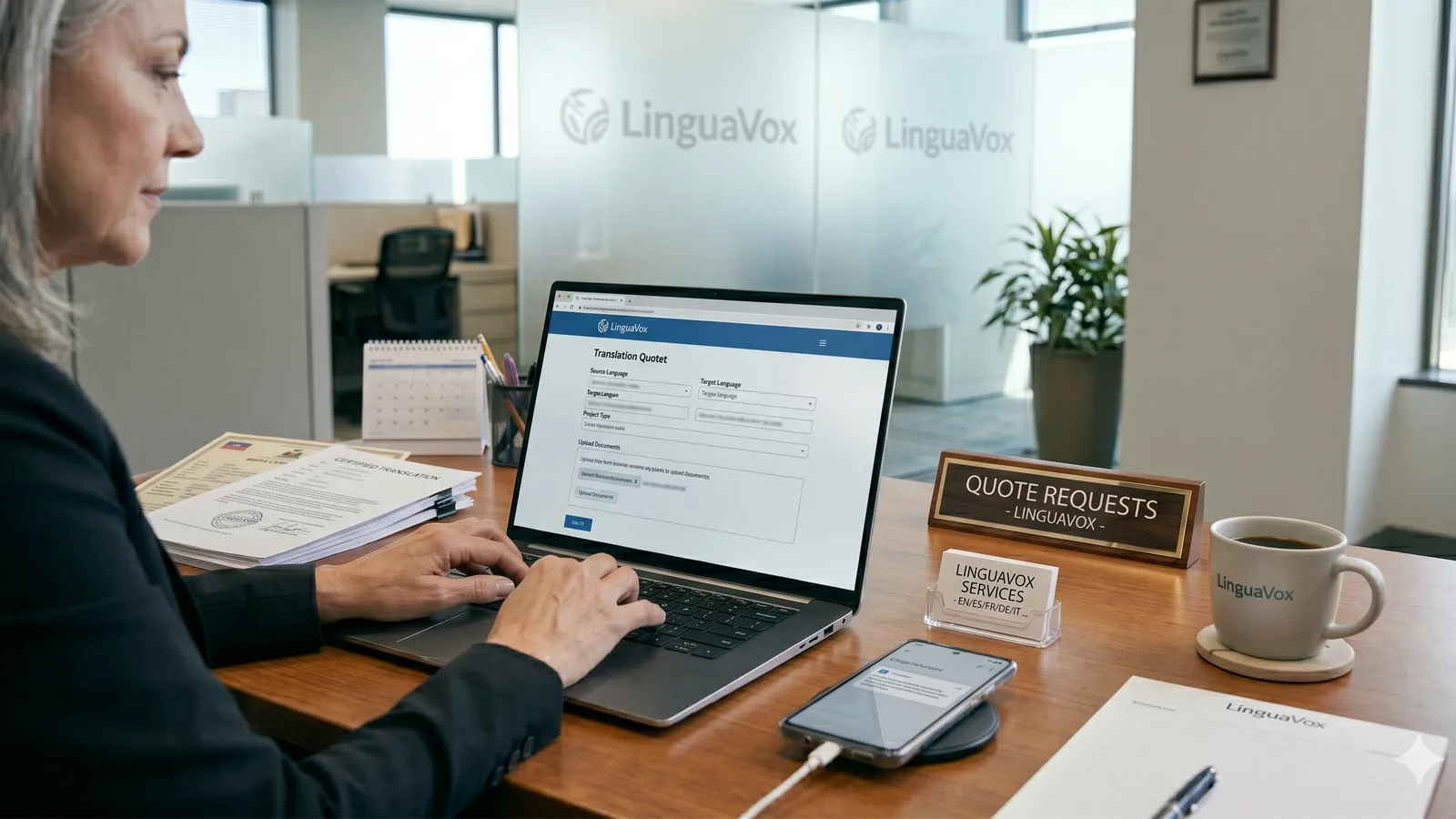
To start a legal translation project, send us your scanned documents or digital files. Please specify the target language and inform us where the final translation will be submitted. Our team will review the document type, assess the formatting requirements, and provide a detailed quote indicating whether standard delivery, a certified PDF, or a mailed notarized copy is most appropriate for your needs.
Quality management system focused on traceability, process organization and continuous improvement.
Specific standard for professional translation services with independent revision.
Standard used for human post-editing of machine translation when that workflow is requested.
Explore related services when your project combines certified translation, USCIS documents, business files, languages or state-specific delivery needs.
We translate a variety of legal files, including commercial contracts, court rulings, witness statements, powers of attorney, corporate bylaws, adoption records, and non-disclosure agreements (NDAs).
If the contract is for internal review, negotiation, or business operations, a standard professional translation in Word format is usually sufficient. If the contract is being submitted as evidence in a court case or to a government registry, you will likely need a certified translation with a certification of accuracy.
We treat all legal files with strict confidentiality. Documents are processed through secure management systems, and our team adheres to non-disclosure practices to protect your sensitive corporate and personal information.
Yes. While many courts accept a standard certified PDF, if your local jurisdiction or attorney specifically requests a notarized translation, we can arrange for the certification to be signed before a U.S. notary through our Michigan contact, followed by postal delivery.
Yes, we regularly translate legal documents from languages that use different writing systems, such as Arabic, Chinese, Russian, and Korean. We use standard transliteration practices to ensure that names and official locations are appropriately represented in English.
Turnaround times depend on the document's length and complexity. A standard power of attorney or a short court order can often be delivered in a few days. For voluminous litigation files, we will evaluate the word count and provide a clear delivery schedule in your quote.
Request a translation quote
Send the documents, specify the language and explain where the translation will be submitted. We will check whether you need certified PDF delivery, notarization or postal delivery.